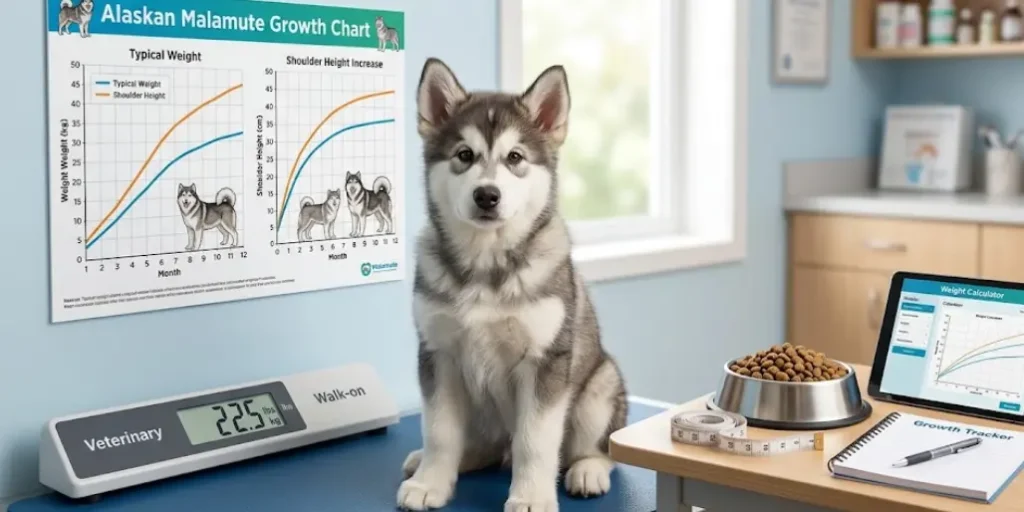
An Alaskan Malamute puppy goes through rapid development, and checking a reliable growth chart helps every owner track their dog’s size and weight to ensure healthy adult growth.
| Monitoring Period | Purpose |
| 8 weeks to adulthood | Compare your young Alaskan Malamute against standard breed growth curves to ensure the giant breed reaches its ideal adult weight without becoming overweight. |
Malamute Puppy Growth Stages
Newborn to 8 Weeks
During the first eight weeks of life, a newborn Malamute puppy depends entirely on mother’s milk and experiences a massive surge in body mass and weight. As a responsible owner, you should watch how this tiny Alaskan Malamute starts to gain pounds rapidly, laying down the foundation for its future giant breed size and robust shoulder height before leaving for its new home.
8 Weeks to 4 Months
At around 3 months to 4 months of age, your growing puppy transforms dramatically as the Alaskan Malamute skeleton and joints develop at an astonishing pace. Every single veterinary check during this phase should focus on proper feeding to support the heavy bone structure, ensuring your young Mal stays lean and matches typical growth curves without putting excessive stress on developing joints.
4 Months to 1 Year
Hitting the 6-month milestone means your Alaskan Malamute is well on its way to adulthood, often tipping the scales past sixty pounds while still needing careful nutrition. Keeping a close eye on your dog’s body condition near 18 weeks and beyond guarantees that this magnificent northern breed achieves its majestic adult height and proper proportions just like standard expectations predict.
Understanding the Growth Chart
Growth & Weight Tool
How big will your puppy get?
Pick a breed to see its typical growth curve, or add your puppy’s current age and weight to check how they’re tracking against the average.
Estimates based on breed-standard adult weight ranges and typical size-class growth patterns. Every puppy is different — check with your vet for individual concerns.
What is a Growth Chart
A growth chart is a handy tool every owner needs to monitor how their puppy gains weight and height over time. By plotting your dog on a standard curve, you can check if your Alaskan Malamute meets the expected size for giant breeds, ensuring a healthy adult dog without any guesswork.
How to Read the Growth Curves
Reading growth curves involves comparing your animal against established breed data to see if your puppy is on track. You just measure the shoulder height and use a reliable tool like the Dog Growth Chart & Weight Calculator to check body condition, ensuring your Mal develops properly week by week.
Average Size and Weight Expectations
Average expectations show that a young Alaskan Malamute will gain massive body mass rapidly, especially around 3 months and 4 months of age. By 6 months, males and females often weigh heavily, heading steadily toward their final adult size, matching the breed standard for tall northern dogs.
Factors Influencing Malamute Growth
Genetics and Lineage
Genetics play a massive role in determining how large your adult Alaskan Malamute will eventually grow. The bloodline dictates the ultimate height and heavy bone structure, meaning your puppy inherits specific traits that define its maximum potential and overall adult weight capabilities.
Nutrition and Diet
Proper feeding is vital because a giant breed puppy requires balanced nutrition to support rapid development without becoming overweight. A smart owner must carefully monitor food intake to protect growing joints, preventing excess fat and ensuring accurate progress toward a healthy adult dog.
Exercise and Lifestyle
Keeping your energetic Alaskan Malamute active is crucial, but you must avoid high-impact stress on vulnerable joints during early puppyhood. A balanced lifestyle with controlled play helps every growing animal build strong muscles and maintain ideal body condition as it journeys toward full adulthood.
To get personalized estimates for your specific dog, try using DogBreedCalc today.
Checking Your Malamute's Growth
Measuring Size and Weight
To accurately monitor your Malamute, you need to regularly measure the shoulder height and body mass of your puppy. Tracking every single measurement ensures that your Alaskan Malamute stays within a healthy growth chart trajectory. Whether you have a male or a female, keeping an eye on the pounds helps you catch any unexpected changes in body condition early on.
When to Consult a Veterinarian
If your growing puppy seems too heavy, looks overweight, or fails to match the expected breed standard, a quick visit to the vet is essential. A professional veterinarian can check the joint health and overall development of your Alaskan Malamute, providing accurate guidance on proper feeding to support safe and steady adulthood.
Using a Dog Growth Chart & Weight Calculator
Plotting your dog on reliable growth curves makes it super easy to compare your animal against typical giant breeds. By using the Dog Growth Chart & Weight Calculator, every dedicated owner can predict adult size, manage daily lbs, and ensure their gorgeous pet achieves a majestic height without unnecessary fat gain.
Final Thoughts on Alaskan Malamute Growth
Monitoring Your Puppy’s Progress
Continually watching how your Alaskan Malamute puppy gains weight from 3 months through 6 months and beyond guarantees peace of mind. Regular comparison against standard metrics lets you adjust feeding habits, ensuring your energetic giant breed develops robust bones and strong muscles while avoiding any risky joint strain.
Preparing for Adult Size
As your adolescent Mal approaches full adulthood, understanding the ultimate adult weight and shoulder height helps you prepare your home for a very large dog. Genetics and proper nutrition dictate how tall and heavy your companion will become, turning your cute puppy into a magnificent, healthy adult Malamute.
Conclusion and Key Takeaways
Raising an Alaskan Malamute is an incredible journey that requires patience, careful monitoring, and proper health checks at every single life stage. By staying informed about breed growth and utilizing smart tools like DogBreedCalc, you ensure your furry best friend lives a long, active, and wonderfully healthy life.
FAQ
Q: How big will my Alaskan Malamute puppy actually get?
A: Honestly, it depends a lot on genetics, but most Malamutes end up somewhere between 75-100 pounds for males and 70-85 pounds for females once they're fully grown. A growth chart can give you a solid prediction, but your pup's parents' size is usually the best clue you've got. If mom and dad were big, chances are your fluffball will be too.
Q: What's a normal weight for a 6 month old Malamute puppy?
A: At 6 months old, you're looking at roughly 40-55 pounds depending on whether it's a male or female. This is kind of a growth spurt phase, so don't panic if your pup seems to be packing on weight fast. By this point they're usually around half to two-thirds of their adult weight, so if your dog is sitting around 60 pounds already at 6 months, you might have a bigger-than-average Malamute on your hands.
Q: How can I tell the difference between a Malamute puppy and a husky puppy?
A: This trips up a lot of new owners! Malamutes are generally bulkier and heavier-boned than huskies, even as puppies. Huskies tend to have blue eyes more often, while malamutes almost always have brown eyes. Malamute puppies also tend to have bigger paws and heads relative to their body compared to husky pups. If you're unsure, a vet or breeder can usually spot the differences pretty quickly.
Q: Is there such a thing as a miniature Alaskan Malamute?
A: Yeah, there's a smaller version sometimes called a miniature or "mini" Malamute, though it's not officially recognized by major kennel clubs. These dogs are bred down in size but still have all that classic Malamute personality and fluff. If you're looking at a puppy advertised as miniature, just know the growth chart predictions for standard Malamutes won't really apply to them.
Q: How accurate are growth charts for predicting my Malamute's adult size?
A: Growth charts are a helpful tool, but accuracy can vary quite a bit from dog to dog. Things like diet, health, and genetics all play a role in how your puppy grows. Most charts get you in the right ballpark, but don't expect pinpoint accuracy down to the pound. Think of it more as a general guide rather than a guarantee.
Q: Should I worry about my Malamute puppy's BMI?
A: While BMI isn't really a standard measurement vets use for dogs the way it's used for humans, keeping an eye on your pup's body condition is still important. You want to be able to feel their ribs without pressing too hard, and they should have a visible waist when you look at them from above. If your Malamute seems too round or you can't feel any ribs at all, it might be time to chat with your vet about their diet.
Q: At what age do Malamutes stop growing?
A: Most Malamutes reach their full height by around 12-18 months, but they can keep filling out and adding muscle mass until they're about 2 years old. So even if your dog looks "done" growing height-wise, they might still be bulking up a bit in the following months.
Q: Why do some malamutes end up bigger or smaller than the average growth chart?
A: Genetics is honestly the biggest factor here. Just like people, dogs inherit traits from both parents, so a puppy from two larger malamutes will likely grow bigger than average. Nutrition, exercise, and overall health during the growing months also play a part. That's why growth charts give ranges instead of exact numbers—there's just natural variation across the breed.
Q: My Malamute puppy seems way off the growth chart—should I be concerned?
A: A little variation is totally normal, so don't stress if your pup is slightly above or below the average numbers. However, if your dog is drastically off track, growing way too fast, too slow, or not gaining weight at all, it's worth getting a vet's opinion. They can check for any underlying health issues and make sure your pup is developing properly.